


Congratulations to Nusantara DFDL Partnership for being one of the finalists in the Asian Legal Business 2025 Indonesia Law Awards!
Our firm has been shortlisted in two categories — Dispute Resolution Boutique Law Firm of the Year and Labour and Employment Law Firm of the Year — a recognition of the team’s expertise in these key areas.
The awards celebrate the best of Indonesia’s legal industry, and we are honored to stand alongside such an impressive group of finalists. Congratulations to all who have been shortlisted. We look forward to the ceremony on 23 October at the Fairmont Jakarta and wish everyone the very best of luck!
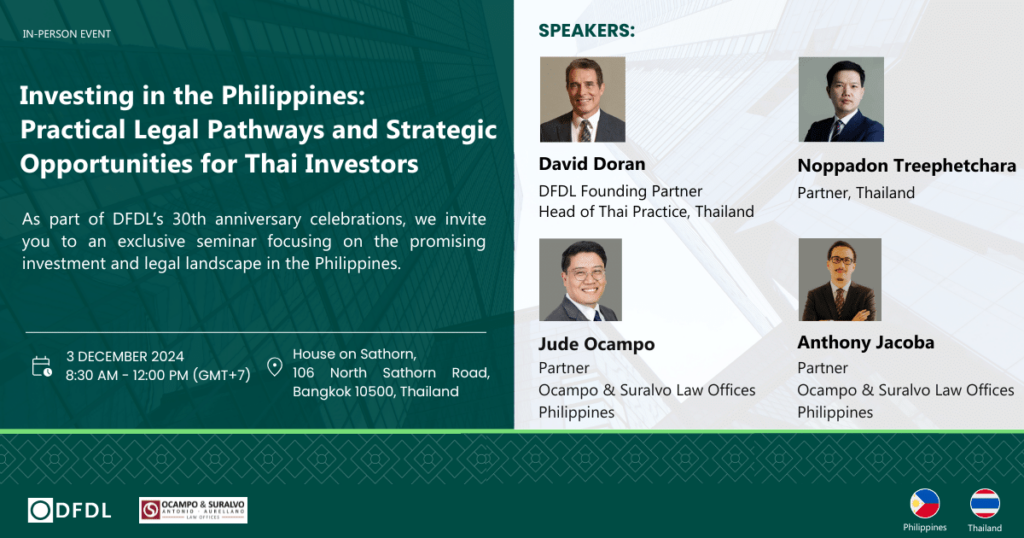
As part of DFDL’s 30th anniversary celebrations, we invite you to an exclusive seminar focusing on the promising investment and legal landscape in the Philippines.
Why Attend?
The Philippines is a market ripe with opportunities for Thai investors. With a youthful population, increasing urbanization, and a commitment to economic reform, the country stands out for those looking to tap into a dynamic market with promising growth prospects.
Join us to explore insights into the key drivers of growth, innovative sectors on the rise, and potential hurdles that may impact investment decisions across legal, regulatory, and business perspectives.
Key Topics
Our Esteemed Panel:
This is a unique opportunity to engage with industry leaders, expand your network, and gather actionable insights that can help you navigate the complexities of investing in the Philippines.
Event Details:
• Date: Tuesday, 3 December 2024
• Time: 8.30 AM – 12.00 PM (GMT+7)
• Venue: House on Sathorn, 106 North Sathorn Road, Bangkok 10500
Exclusive Event:
Reserved for Business Executives and General Counsels, with complimentary admission.
Special Offering:
1:1 meetings available upon request.
RSVP by November 30 to secure your seat. We look forward to welcoming you!
DFDL Myanmar is honored to be part of the 13th edition of ‘Global Legal Insights – Litigation & Dispute Resolution 2024’, a prestigious publication by Global Legal Group.
In this edition, Nishant Choudhary, Partner and Head of DFDL Dispute Resolution Practice, supported by his team of legal advisers, namely Rohan Bishayee, Mar Mar Aung and Kyaw Kyaw Han, authored the section on Myanmar’s dispute resolution laws and regulations. The team has meticulously curated the chapter to ensure that the information pertaining to dispute resolution in Myanmar and cross-border litigation aligns with the contemporary legal environment.
The chapter provides a comprehensive overview of current arbitration and court procedures, offering practical insights and analysis on a wide range of matters such as class actions, interim relief, alternative dispute resolution, and enforcement of judgments and awards, among others.
These insights are designed to equip both local and international stakeholders with the knowledge necessary to make informed decisions to navigate Myanmar’s dispute resolution mechanisms effectively.
To access and read the full chapter, please click on the below button:
DFDL is excited to announce that Afriyan Rachmad, Partner at Nusantara DFDL Partnership, DFDL’s affiliate firm in Indonesia, has been named one of Asia’s top 50 dispute lawyers in the prestigious ALB Asia Super 50 Disputes Lawyers 2024 ranking by Asian Legal Business.
This recognition acknowledges Afriyan’s exceptional client service, proven track record in handling high-profile disputes, and his dedication to achieving the best outcomes for his clients.
Read more about the ranking here: https://www.legalbusinessonline.com/features/rankings-alb-asia-super-50-disputes-lawyers-2024
DFDL has made a significant contribution to the 25th anniversary issue of the Asian Dispute Review. This edition features insightful analyses from our esteemed colleagues, Nishant Choudhary, Partner, Managing Director (Myanmar); Regional Head of Dispute Resolution Practice, Rohan Bishayee, Legal Adviser (Myanmar and Thailand), and Ngan Tran, Junior Legal Adviser (Vietnam).
Our team has delved into the intricate dynamics of arbitration versus local court litigation in Myanmar and Vietnam, providing readers with a comprehensive understanding of the benefits and challenges associated with each dispute resolution method. The comparative study offers valuable perspectives for practitioners and clients alike.
The Asian Dispute Review is renowned for its authoritative content on dispute resolution in Asia, and DFDL’s contribution underscores our commitment to thought leadership in this field. We are honored to be part of such a prestigious publication and to share our expertise on a platform that reaches a wide audience of legal professionals.
Download the article on below download button.
We are pleased to announce that DFDL is extending its PRC network of collaborating firms through a cooperation agreement with Leaf, a distinguished law firm renowned for its expertise in Greater China, and offices in Shanghai, Beijing and Paris. Leaf’s Sino-European team has been recognized for its expertise on cross-border M&A transactions, corporate finance and fundraising. Leaf also has a significant cybersecurity and data protection law practice complemented by a team of technical experts. This collaboration initiative will strengthen DFDL’s European Desk and allow us to join a hub of professionals to coordinate work for Asian projects from Europe, both inbound and outbound, with a primary focus on European clients.
Established in 1994, DFDL is a leading international legal, tax and investment advisory firm with a robust presence across South-East Asia, boasting twelve offices across 10 countries including Bangladesh, Cambodia, Indonesia, Lao PDR, Malaysia, Myanmar, Philippines, Singapore, Thailand and Vietnam. DFDL and Leaf are multi-awarded law firms highly recognized for their knowledge and understanding of the legal and regulatory landscapes within their respective markets.
We are looking forward to this cooperation to expand our business horizons and, most importantly, to ensure that we continuously deliver seamless service to our valued clients.
For additional information, please feel free to contact Guillaume Massin ([email protected]) and Bruno Grangier ([email protected]).
Recent Indonesia Supreme Court Circular Letter No. 3 of 2023 Covering Notable Supreme Court’s Interpretation of Certain Key Areas of the Laws
Supreme Court of Indonesia as the highest judicial system in Indonesia commonly issue a circular letter to all head of court of first and second level as guideline for the judges across Indonesia to achieve uniformity in the application of the law and consistency in every court decision. Recently, Supreme Court issued Circular Letter No. 3 of 2023 regarding The Implementation of the 2023 Supreme Court Plenary Meeting Results as Guidelines for the Implementation of Duties for Courts (“CL 3/2023“).
Key Highlights
1. Search in Building or Premises
Supreme Court provides guideline for the Head of District Court in granting permission for search in building, office, agency or institution at the request of an investigator. Nowadays, the searches permit must specify the place and room in detail where the search is intended to be carried out.
Our view: It is now clear that detail of place and room in search or dawn raid is important in the search permit for companies in allowing investigator to conduct search during investigation process.
2. Agreement made without Indonesia Language
The guideline prescribes that judges cannot use reason/basis of annulment for agreements that do not have Indonesian language in such agreements involving foreign parties and Indonesian parties, among others Indonesian companies and/or individual, unless it can be proven that the absence of an Indonesian language version in the agreements are due to bad faith by one of the parties.
Our view: Notwithstanding this guideline, we are of the view that proving “bad faith” by a party will be a difficult task as there is no clear definition of bad faith. Our view remains the same which is to advise parties to prepare bilingual language agreement (one of which is Indonesian language) if the contracting parties are foreign and Indonesian. This is also in line with Law No. 24 of 2009 on National Flag, Emblem and Anthem.
3. Termination on Specific Time Work Agreement Employee
Supreme Court states that workers/laborers pursuant to Specific Time Work Agreement/Perjanjian Kerja Waktu Tertentu (“PKWT”) who are being terminated before the expiry of their employment period, will be entitled to receive both (i) compensation, and (ii) severance pay of which the severance pay shall take into consideration the tenure that has been completed.
Our view: It provide clear guideline upon the issuance of Omnibus Law particularly related to the employment law matters.
4. Bankruptcy and Suspension of Debt Payment Matters (PKPU)
CL 3/2023 provides guidance related to insolvency and suspension of debt payment (PKPU) cases particularly on Foreclosed Collateral/Agunan Yang Diambil Alih (“AYDA”). Under the CL 3/2023, AYDA shall not be constructed as a sale and purchase transaction of collateral objects; instead, it shall be constructed only as an act of voluntarily submission or hand over collateral objects to the bank for the purpose of selling the objects as debt repayment. Unsold Foreclosed Collateral or AYDA shall not change the creditor’s status and therefore, it remains as a secured creditor, and AYDA object shall remain registered in the list of bankruptcy assets (Boedel Pailit). If the AYDA object has been successfully sold, and there are still outstanding receivables, the creditor still has right to request payment to the debtor in which the remaining outstanding receivables shall be considered as unsecured debt and the creditor will be considered as an unsecured creditor.
CL 3/2023 also provides guideline for supervisory judge who carry out his/her duties in bankruptcy or PKPU cases, to always refer to the information available in Financial Information Services System or Sistem Layanan Informasi Keuangan (SLIK) at the Financial Service Authority or Otoritas Jasa Keuangan/OJK. Bank is obliged to update their data to determine the debtor’s status.
The Supreme Court is also of the view that a case/dispute related to a bankruptcy or PKPU petition against an apartment and/or flat developer shall not be considered as a case that fulfilled requirements for simple evidentiary regulated under Article 8 of Law No. 37 of 2004 regarding Bankruptcy and Suspension of Debt Payment Obligations (“Bankruptcy Law“). Consequently, it will be more difficult to file a bankruptcy or PKPU petition against an apartment and/or flat developer.
Our view: These 3 updates in bankruptcy and suspension of debt payment (PKPU) matters are important for clients in the field of banking sectors or clients who is in the restructuring stage. There may be issue related to this matter since there is an inconsistency with the existing laws and regulations. CL 3/2023 is not in line with Article 8 paragraph (4) of Bankruptcy Law, which requires that the request for bankruptcy must be granted if there are facts or circumstances as per prerequisite under Article 2 paragraph (1) of the Bankruptcy Law have been fulfilled. These requirements include the existence of two or more creditors and debts that have matured and outstanding upon submission of bankruptcy or PKPU request. We are of the view that Insolvency and PKPU petition against apartment and flat developers shall not be deemed as simply proven, it will not only affect the creditors; hence it also affect the developers themselves as they will no longer be able to voluntarily file bankruptcy and PKPU petitions.
The information provided here is for information purposes only and is not intended to constitute legal advice. Legal advice should be obtained from qualified legal counsel for all specific situations.
